
You are what you eat. Don’t eat anything fast, cheap, easy, or fake. pic.twitter.com/GbuyT9Fgx3
— PaleoMarine (@ThePaleoMarine) August 8, 2016
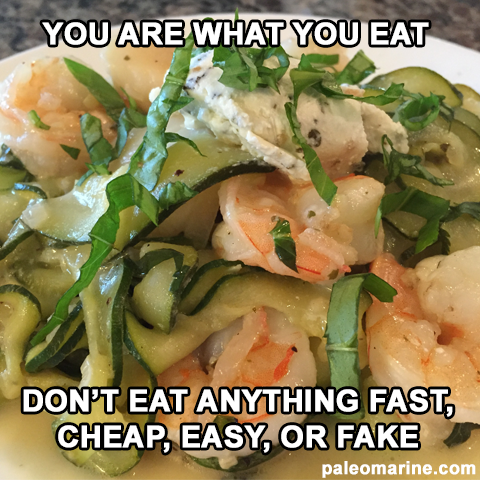
You are what you eat. Don’t eat anything fast, cheap, easy, or fake. pic.twitter.com/GbuyT9Fgx3
— PaleoMarine (@ThePaleoMarine) August 8, 2016
I’m a firm believer that all a person needs to do to get healthy and to lose weight is to eat natural foods without overindulging. I’m not even saying no carbs: just avoid high-carb foods. The reason I’m a firm believer is because within 10 months, I lost over 100 lbs. I did that without any pills, supplements, vitamins, surgery, drugs, or any other method used to put chemicals into the body. I did it naturally.
I know people who use certain products in their quest to become healthy. I personally believe that these products aren’t really necessary, but for some people, it seems to help. Some of these products claim to reduce hunger or give people energy, but in my experience, if you cut out high-carb foods and anything processed with added-sugar, those things happen naturally. If the foods you eat are natural, they will contain lots of nutrients and vitamins that will keep you full and give you energy. You will find yourself n not hungry between meals unless you ate a light meal.
Exercise, done smartly, is beneficial all around. As long as you’re careful and don’t overdo it, I recommend it. I don’t do any crazy difficult exercise regimen, but I do use kettle bells and walking to get the muscles moving and in shape.
I can’t say the same for the diet industry. I haven’t seen any neutral third party scientific evidence that supports the assumption that these products aid in the loss of weight. Further, in every one of the products, even in their own descriptions, they say “Coupled with a sensible diet and exercise…” Well, duh. If you do the sensible diet and exercise part without their product, guess what’s going to happen? You will lose weight.
Be smart and put good food into your body. Avoid sugar, processed foods, or high-carb foods. Get some exercise. Stick with this regiment for life. Only then will you see your weight drop and stay down.
We all have different reasons for why we’re here. Some of us want to lose weight. For some, there’s a lot of weight to lose while for others, not so much. Then there are those who want to get healthy, or who want to eat more natural foods. All of these reasons are unique, and special, and valid. They all brought you here, and you took the first step in getting healthy and/or losing weight.
There are those of you who are already in, either doing or have done a Whole30 and are either going or have already gone to a Paleo lifestyle. That’s great! I look at other sites all the time to gain more insight, knowledge, tips, and tricks on how to live my life better.
It doesn’t matter to me what your motivation is. What matters is that you take this seriously and really dedicate yourself to getting healthy and/or losing weight. Don’t do it for my sake. I’ve lost a ton of weight and I’m healthier than I’ve ever been. I’m asking you to take it seriously for YOUR sake. This is all about you.
This is the convergence of all those reasons and motivations. This is the point at which we all come together and head into a common direction: to get healthy. The cost? Dedication.
I never said it was easy. I never said it was effortless. What it is, though, is satisfying. When you begin to feel better or start feeling your clothing get loose, it feels great. These are the payoff fr your dedication. You have no-one to thank but yourself. I may be an inspiration or help you with motivation, but ultimately, you have to do this for yourself.
You can do this.
For those who have never played any of The Sims computer games, please bear with me. According to Wikipedia:
The Sims is a life simulation video game series, developed by EA Maxis and published by Electronic Arts. It is one of the best-selling video games series of all time.
It’s fascinating how they have simulated personality types so well in the game. Growing up, my kids would often refer to other people based on the type of sim they were closest to: “Oh, that person is a family sim. That person is a money sim.” As for me, I’m a knowledge sim. According to The Sims Wiki:
Sims with the Knowledge Aspiration want to know everything there is to know about anything. Make sure they have the time to study and explore every nook and cranny. Their lives are a simple equation: the more Knowledge, the higher the Aspiration Meter, and the longer and brainier the life.
I want to learn as much as I can on any topic, subject, or hobby that I’m taking an interest in. Whether it’s radio controlled aircraft, coin collecting, or military history, I read voraciously, trying to learn as much as I can. When it comes to nutrition and Paleo, I’ve been doing the same. It’s not just a hobby or a diet for me: it’s become my lifestyle and my passion.
With that aspiration to learn as much as I can comes the reality that sometimes I have to change an earlier misconception or correct the knowledge nugget in my head. One of these is referring to Paleo as no-carb or low-carb.
In reality, Paleo allows carbs, but it cuts out foods that are dense in carbs as a proportion to their mass. This is a huge distinction, as people who are knowledgeable about our body functions correctly assert that the human body runs off glucose which is most easily metabolized from carbs. However, this doesn’t mean our bodies are built to sustain the carb onslaught we put it through every time we eat grains and legumes. Our bodies, in their efficient form, try to get every bit of energy out of the carbs we eat. If we eat more than we need, our bodies store that in the form of lipids, also known as fat. By limiting our carbs to reasonable levels, our bodies won’t overproduce energy and will not be in a position to store it.
In earlier posts, I’ve written about Paleo being low-carb or non-carb. These are not correct phrases, and I will be eliminating them from my dietary vocabulary. Paleo limits carb-dense foods: this is true, but it does not eliminate carbs nor is it low-carb. It’s lower carb than the average American diet, to be sure, but I think the focus should be on eating foods that nutritionally make sense for us. Carb-dense foods just don’t fit into the logic of a balanced diet.
The importance of this change in terminology is huge: I find people are immediately turned off when they hear no-carb or low-carb, but when you talk about limiting carb-dense foods and replacing them with more reasonable carb content foods, people seem to find this reasonable and logical and can more easily consider adopting a lifestyle that will help them lengthen their lives, increase their quality of life, and even lose weight.
What is keeping you from going all-in on your health? What are the reasons why you haven’t yet been able to change your lifestyle from the one you currently live on to one that is healthy and more sustainable? What logic have you been using to keep yourself from making a change that can lengthen your life and allow your quality of life to improve? Whatever these arguments have been, you need to take a hard, long look at yourself and really think about whether these reasons are beneficial to you and your goals in life.
I never said that getting healthy and losing weight is without effort. I did say it felt easy for me as compared to what my perception of how hard it would be was. Was it a cake walk? No (and man, I love cake!), but it wasn’t nearly as difficult as I made it out to be in my head. Just like anything, we build things up to be harder than they usually turn out to be unless we’re talking about a trek up Mount Everest: nobody expects it to be as hard as it turns out to be. Every time (and no, I haven’t done it myself, but I know people who have, and they all say the same thing, so I believe them).
I think the foundation upon which all objections to changing one’s lifestyle from whatever a person is eating now to one that is healthy and sustainable is based on their relationship with food. If you remove your love of pasta, bread, beans, rice, potatoes, etc, then it’s hard to argue the logic of eating foods that are not dense in carbs.
Until you can separate your love of foods from the decision required to accept the logic of eating foods that are healthier for you, it will be difficult, if not impossible, to change your lifestyle in a meaningful way. I say this from not only my own experience, but from what everyone I know who has been successful with Paleo has told me. People who struggle with Paleo or with doing a Whole30 have one thing in common: they have not come to grips with the relationship with food and haven’t made the long-term commitment to break up with those foods that are hurting them. Until you do that, you’re fighting an up-hill battle.
Is this a good idea?
We are a marketing-conscious society. We love brands: Audi, Yamaha, Apple, HP, Nike, Eddie Bauer, Duluth Trading, etc are all brands that have solid reputations and followers who trust those brands due to personal experience with value, reliability, and long-term support. There are other brands that people don’t understand and are maligned, unfairly, in my opinion: Yugo (they were surprisingly solid and reliable little cars, although very spartan), Ford (ask any Chevy fan), Chevy (ask any Ford fan), and Triumph (their cars were notorious for being mechanically difficult to keep running in the 70’s; their motorcycles are actually really quite good) to name a few. Another maligned brand that is often dismissed without further consideration is Paleo.
When you look at the logic behind the Paleo movement, it’s easy to be dismissive:
The Paleo Diet is an effort to eat like we used to back in the day…WAY back in the day. If a caveman couldn’t eat it, neither can you. This means anything we could hunt or find – meats, fish, nuts, leafy greens, regional veggies, and seeds. – nerdfitness.com
Personally, I have no interest in living like a caveman. I like air conditioning, computers, and my LCD TV too much. Don’t even get me started on having to discover fire all over again! Seriously though, when it comes to our bodies, they have not been able to keep up with the most important technological advancement in the past 10,000 years: agriculture.
In the grand scheme of things, agriculture is a relatively new technology. Our bodies have not evolved quickly enough to be able to handle the excessive amount of carbs present in grains that are the mainstay of modern agriculture and thus, the modern diet. Grains are not bad for us, per se, but they are packed with a ridiculous amount of carbs that are too easy for us to over consume. For people who struggle with weight and are trying to lose weight, carbs have to be limited. Notice I didn’t say eliminated: I’m not talking about the Keto diet here.
While the Keto diet can be very successful for people who want to lose a lot of weight quickly, it is not without its difficulties. It is very difficult to put the body into ketosis while inversely easy to kick out of ketosis with one high-carb food item. I’ve dabbled with ketosis and had great success with it, but I found it was very difficult to maintain while eating with my wife and family. I settled on Paleo and I have been extremely happy with the weight loss rate and the satiety of the foods and with how much energy I have.
The reason I mention all this is because Paleo gets a bad rap. People hear the word “Paleo” and they immediately think of cavemen (duh!), eating nothing but meat (a common misperception), and they hear the talking heads in medicine and nutrition circles deride any diet that restricts any food group (Paleo restricts grains, dairy, and legumes).
When I talk to people about Paleo, I rarely mention the name of the diet until about mid-way through my pitch. I want people to consider the science, the logic, and the bio-mechanical aspects before they pass judgment on what I’m doing and what may work for them.
The Audi brands of cars used to be known for not being reliable. Today, they are in the top 2 most reliable luxury cars on the market. Perceptions can change. The Paleo diet works, and it works well. It’s easy to adhere to and it is not as restrictive as people may have led you to believe. Give it a try, and don’t fall for the negative hype.
At the grocery store, I overheard a clerk telling a customer that he was using diet to change his weight. He said he was going into the Army and needed to both lose weight and get into shape before they would accept him. The lady he was talking to asked him what he was doing, and the clerk responded, “I’m cutting out high-carb foods by not eating meats like beef and pork.”
I was confused, so when it was our turn to be checked out, I asked him what he was doing, and he repeated the statement about the low-carb meats. As hard as it was for me to not correct him, I didn’t do it. He continued on by telling me that he was miserable and having a hard time with eating just chicken and salads. He said it was tough going, and that he wasn’t sure he could keep it up. I told him that he needs to do what works best for him, and what worked best for me included eating red meat and pork. I told him that he needs to find a diet plan that will allow him to enjoy the foods he eats, be sated, and not miserable. Sherry then said, “All you need to know to get started is Whole30. Go to whole30.com and read. Just learn about foods and then make your decisions from there.”
She was absolutely right. This clerk was receiving some really bad information from a friend he trusted. That friend is naturally thin and the clerk, a heavyset young fellow, believed that if he ate what his thin friend was eating, he too would become thin. The problem with this is that we all have different genetics and foods affect us all in different ways. Someone who has never been fat can eat a lower calorie diet and stay thin while a person who is overweight will struggle with hunger and satiety on the same diet that ultimately will derail that person.
Gaining a knowledge about what food is made of, how it is digested and turned into energy, and also how it is stored in our bodies is something everyone should have a fundamental knowledge of. Just like we understand that our cars use unleaded fuel, and that premium unleaded has higher octane than regular unleaded, so should we understand that certain foods have higher ratios of carbohydrates than others.
It’s important to understand that our bodies are built to run on glucose which comes from carbohydrates. That’s why people in the medical profession have a negative knee-jerk reaction to any diet that restricts them. What they miss is that Whole30 and Paleo don’t get rid of carbs from the diet. They restrict foods that are unusually high in carbs that allow people to easily consume too many of them. Going back to the fuel analogy, carbs are the octane in our fuel (food), but in the case of our bodies, too much of it in our food gets stored and weighs us down.
I have said it numerous times before: find what works or you and do it. The worst thing you can do about your weight and health if you are overweight is to do nothing. Whole30 and Paleo worked for me, and I think you should take a look and try them. At least the Whole30, and then decide what’s best for you based on that. You will feel better, and your body will be healthier. And yeah, you’ll lose some weight, too.
I was thinking about it this morning; I’ve lost over 104 lbs since September 1st of last year, and I feel so much better than I have in years. Heck, I feel better now than even in my last few years of active duty in the Marines. My mind jumped to what I used to use as my stock answer when someone would suggest I should lose weight: “But then there would be less of me to love! I can’t have that!” It made me feel good to have a funny answer to everyone who would have the guts to mention to me that my weight was unhealthy. These sweet people cared enough to break the polite silence we exercise when it comes to other people’s health.
A former colleague of mine, a giant of a man, asked me one day while we were driving to lunch together, “How’s your prostate?” I was surprised, but being the immodest person I am, I took it in stride. “I think it was fine the last time I got it checked. How’s yours?” He told me he asked because it’s something guys don’t ever talk about but should. He told me of his friends who had all been diagnosed with prostate cancer, and that one of them caught it too late. When he found out the others also went through it, he was upset that had they discussed it freely, that one friend of his might still be alive. He told me how men don’t talk about their health in the same way women do. It’s a forbidden topic, and it’s more acceptable to practice polite silence on the matters of health.
The vast majority of the time, people practiced that polite silence with me and my weight. I do the same with people I know, whether they are friends or colleagues. I have never pushed my lifestyle on anyone, nor have I advocated anyone else adopt my lifestyle unless they were curious and asked me. Even then, when asked, I gladly tell people what I do and why. I try to explain the science, as best I can, about why this lifestyle works, and what my experience has been thus far. Only when someone tells me that they want to do what I did will I give direct advice on how to do it, what to do, etc.
The only way in which I will break the polite silence is by telling people that I wasn’t always this fit when they point out to me that I don’t have to worry about what I eat, my weight, etc. Yes, it happens to me now: I’m told that I’m lucky my genetics allow me to be thin. AS IF!
I worked hard for this weight loss. Not in sweat (thankfully!), but in discipline. That was the key to my weight loss. My wife did some exercise, but she’s lost the majority of her weight through discipline as well. She had been heavy her entire life and is now fit and healthy due to the change in her diet. We are both examples of two different people: one who was thin and one who wasn’t. We were both overweight and now both of us are normal. We’re not atypical or outliers: we are the norm when it comes to what you can expect when you eat the right foods in the right amounts.
I practice polite silence. We all do. It comes down to our comfort levels as much as it does our cultural norms and what our society finds acceptable. While I don’t think it’s ever right to walk up to someone and say, “You’re fat and you’re going to die unless you eat right,” I think we need to have a conversation with those we love and care about when they’re overweight and let them know that there are options out there that anyone, even those who cannot exercise, can do and they can lose weight. It’s not impossible, and nobody is a lost cause. It just takes determination.
Reach out for help if you’re one of these people who need some extra motivation. Whether you contact me or someone else you know who has lost a lot of weight, get help. My wife and I had my cousin Sarah to bounce ideas and thoughts off of. Sarah received many a text message, email, and phone call from me in the beginning as Sherry and I didn’t really know what we were doing. Now, we’re well versed and into the lifestyle and we can help.
In the most polite way ever, let me say this: If you’re overweight, do something about it. It’s within your power. I know you think it’s hard or that you will suffer, but you are worth it. YOU ARE WORTH IT. And it’s not nearly as bad as you think it will be. That, I can promise you.
A few months back, I talked about a family member who was told by a doctor to adopt a low-fat diet, and that carbs were “Just sugar, and okay.” At the time, I was incensed and felt that the advice bordered on the criminal considering the health issues the patient was being seen for. However, it was just another example of how the medical community is stuck in the dark ages as it pertains to nutrition and diet. The irony is strong considering I am more nutritionally enlightened as a Paleo adherent than the majority of health professionals out there today.
I stumbled across this great article about six reasons they don’t trust mainstream organizations about diet and nutrition, and they echo exactly the same six reasons I have. These are the six reasons I give people verbally when we talk about diet and nutrition. I could restate it all in my own words, and I have over the course of many blog posts and conversations with people, but Kris Gunnars did such a good job, I feel it’s just smarter for me to link to their article than to write my own.
Go read it. I’ll keep today’s post short so you can devote your PaleoMarine time (haha, as if you actually set aside time for this!) to reading this great article. It’s so important, I’m going to post a link to it in my Required Reading section of this blog.
 Paleo Marine