I feel good

I want to sing like James Brown. “I feel good!” HEY!

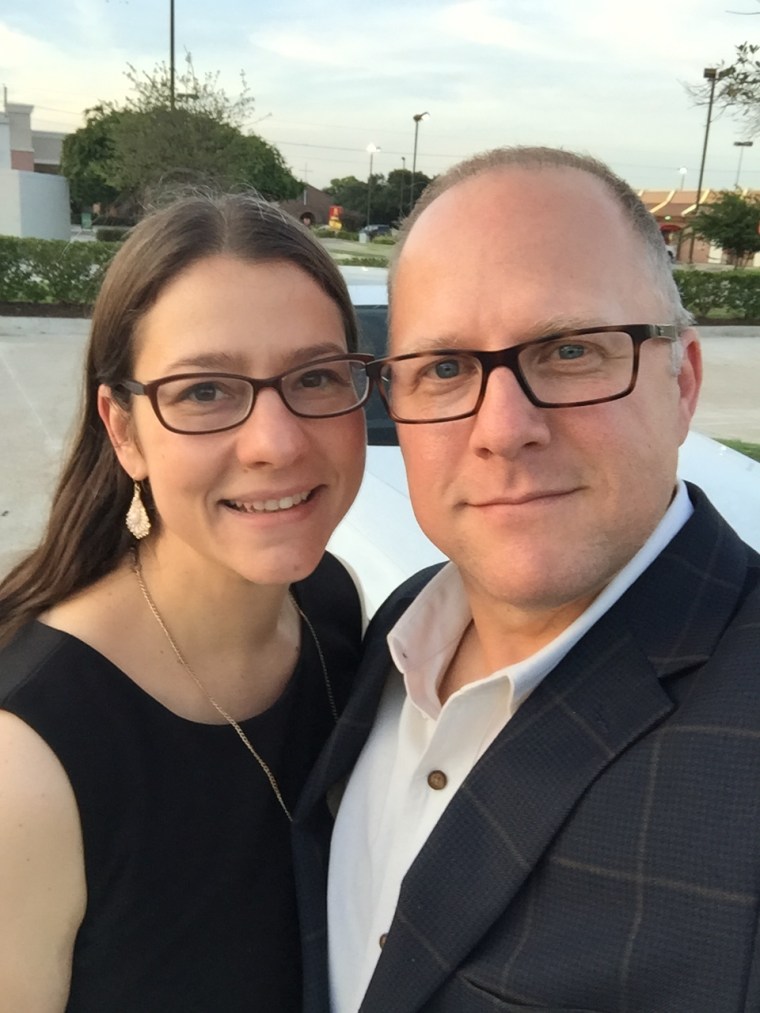
Sherry and I were sitting by the pool last night as I was smoking a new pipe with some new tobacco (very low in carbs… lol) and we were talking about the changes our bodies have undergone in the past year. Both of us commented about how much thinner our legs have gotten since losing all the weight. While our legs weren’t what I would call fat, they were very big and muscular. They had to be: they were carrying a lot of extra weight every day.

As we’ve lost weight, so have we lost muscle in our legs, most notably, our calves. They are noticeably smaller now. We also have much smaller thighs which allows us to sit with our legs crossed comfortably. I can sit with crossed legs in any chair now.

I also noticed that sitting outside last night by the pool, I wasn’t sweating nor did I even feel that hot. I felt comfortable; the amount of sweat my body was producing was enough to actually keep me cool and didn’t accumulate on me as it evaporated. In the past, I would sweat too much which would keep the heat trapped inside and would make me sweat even more profusely. What a difference!

These changes have happened to Sherry and I within a year, which makes it feel very fast to us. In our heads, we are still the fat people we were a year ago. Seeing ourselves in the mirror is still strange, and feeling small within our “New” bodies is a strange experience. Notice, I didn’t say a bad experience: It’s freaking awesome!

We talked about how we no longer are tempted by high-carb or high-sugar foods anymore. While our ways of coping are different, my method involves realizing that the small moment of gratification is not worth the long-term satisfaction of being healthy and lighter (and thinner!). I just can’t justify eating foods that are unhealthy anymore unless at a celebration, holiday, or special event, and even then, in very small amounts.

I don’t ever want to feel the way I used to. Not ever again. I felt tired, worn out, and sore all the time. I was embarrassed for my size and my inability to fit into booths at restaurants or to sit comfortably in airplanes. Now, my motivation is strengthened by my love of how I feel. Like I tell people all the time when they ask me if I miss pizza: “I love being thin more than I love pizza.” And I love pizza a lot.
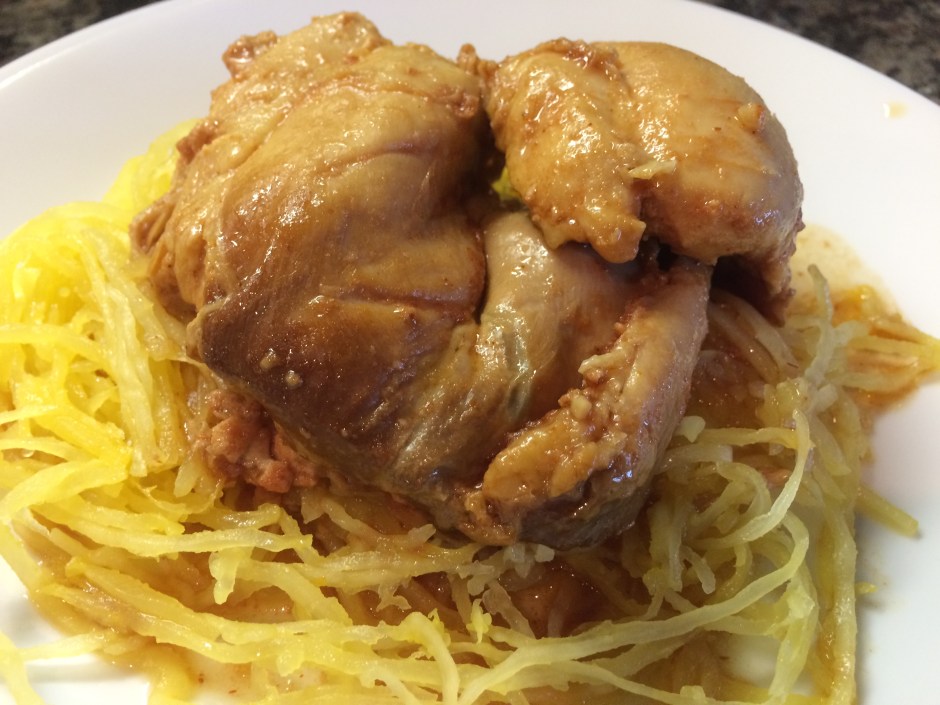
Sweet Chipotle Slow Cooker Chicken

This is a dish that Sherry made for us that is an original recipe. I highly recommend it!!!

paleosherry's avatarOur Daily Bacon

This one is a merging of several recipes into one simple slow cooker meal – sweet and spicy (but not too hot) and sure to be a new favorite in your house.

Ingredients

  • 1/3 cup honey
  • 1/3 cup apple cider vinegar
  • 1 small can tomato paste
  • 1 cup coconut aminos
  • 5 cloves garlic
  • 1 1/2 tsp chipotle chili powder
  • 2-3 lb chicken pieces

Instructions

  1. In a bowl, mix all ingredients together until fully combined
  2. Place chicken in slow cooker
  3. Pour honey mixture over chicken
  4. Set cooker on Low for 5 hours

See, I told you it was simple!

View original post

Staying the course

I keep myself motivated by reminding myself any time I have even the slightest thought of eating something that isn’t on my good list that I’ve come a long way, it was hard work, and I don’t want to slide backward in my progress toward 165 lbs. I have been good so far, and haven’t had any moments of weakness, but I am not immune from the memories of chocolate cake, cookies, and pizza.

When the thought comes to me, I’ve employed a little trick that seems to work well for me: I remember the flavor, I remember how I enjoyed it, and then I put it out of my mind. Just like that. It’s no Jedi Mind Trick, but it works for me.

I am recovering from a food addiction. I used to eat for the pleasure of eating. I used to eat because it was entertainment. I used to eat because I was addicted to it. Now, I’ve got it under control by eating three times a day and eating standard portions. I am very strict about it, and I don’t allow myself any leeway.

I am doing this for me, first and foremost. I am selfish, and I want to enjoy grandchildren one day. I want to enjoy dancing with my wife. I want to enjoy annoying her for many years to come. Of course, I am doing this for my wife and kids, too, but the person I least want to let down is myself. I’ve put too much energy into this to let it go to waste.

File_000 (7)
Sherry and I have come a long way in the past eleven months.

I feel so good now, I never want to go back to how I felt before. Not just physically, but emotionally. I stay the course because all other options lead to failure, and failure is not an option. I will adapt, improvise, and overcome. You can do this, too. Just commit to it.

Straighten up and eat right!

yawye

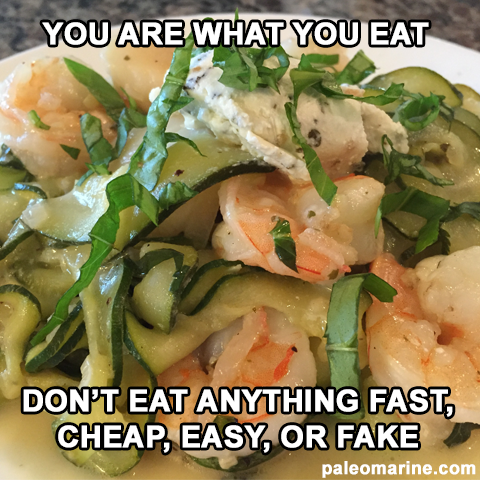
Forget what I’m doing. Forget what anyone else is doing. We want to concentrate on what you’re doing in terms of nutrition. Are you eating right? Can you name every ingredient in the foods that you’re eating? What about the drinks? If there are words you can’t pronounce in the foods you’re eating or drinking, then chances are you’re not eating right.

A good, simple rule that Sherry and I follow is that if we know what all the ingredients are (and we can pronounce them!), it’s probably good food. Most pre-processed foods have not only a lot of added sugar or fillers made from grains in them, but also a lot of chemicals. Some of these are used as preservatives while others are used for flavoring. Many of these chemicals are not the kind of stuff you want in your body. At least I don’t. But again, this isn’t about me.

Are you eating foods that are natural? Are the foods you eat prepared by you or someone in your home? Does this food fill you up and allow you to make it to  your next meal without cravings in between meals?

Do you avoid high-carb foods? Do you avoid pre-processed foods? Do you avoid foods with added sugar?

If the answer to these questions are, “No,” then you really should take a look at what you eat and your health. In this post, I’m not telling you what to do. I’m recommending you look at what you are already doing and analyze how much of your current health is related to the foods you eat. Overweight? Food. Non-Alcoholic Fatty Liver Disease? Food. Type 2 Diabetes? Possibly food. High cholesterol? Food (and not the foods you think!).

Take the time to be honest with yourself and perhaps make a food log for a day or three. Take a look at what you’re eating and look up the ingredients list for them. Look up the nutritional information for these foods. Then, for a next step, investigate lifestyle changes that can improve your health and help you lose weight.

That ol’ Cabbage Soup Diet

Remember the 80’s? Back before the Internet, when people shared information, it was likely done in the form of a mimeograph or what we used to call “Xerox copies.” I remember my mother bringing home one of these mimeographs of something called The Cabbage Soup Diet that was supposedly developed by a cardiologist who swore that this soup was the cure to heart disease and obesity. The recipe was pretty simple and full of vegetables, and as soups go, pretty healthy. The mimeograph stated that one could eat as much of this soup as they wanted, but just this soup. The problem is that this is a very bland soup and after eating it for two or three meals, you get bored.

Thankfully, in the Internet age, we have access to lots of ideas, opinions, and information so that we can make our own decisions based upon all the information posted online. This also allows for discussion around what works, what doesn’t, and most importantly, why. The Cabbage Soup Diet is a deprivation diet: it cuts out a lot of food groups and restricts food groups dramatically.

I overheard two co-workers talking this morning, and one was advocating this very same soup. I know that this “Diet” is still out there, as my own mother-in-law is an adherent. When they co-workers saw me approach, one of them asked me, “What do you think about the Cabbage Soup Diet?” I told them that I personally couldn’t do it because I need variety and a more varied diet. I need to be able to have meats, vegetables, fruits, and in various forms. Its the variety that allows me to stick with eating good, whole foods and keeps me from wanting to quit the Paleo lifestyle. This is very important to Sherry and I; we have to have delicious foods.

I am not a fan of diets that are restrictive or bland. Some people may try to claim that Paleo is restrictive, but in actuality, it’s not. I eat meat, vegetables, fruit, and even some dairy from time to time. I have eggs daily. All the nutrients a human needs comes from the foods I eat. What I have cut out of my diet is high-carb foods: grains, beans, and anything with added sugar and most dairy.

Whatever you do, make sure it’s something that is healthy for you and that you can stick with. Changing your diet temporarily is never going to work for the long term. Moderation is not something people with eating issues can do successfully (ask me how I know). The only real way to make a permanent change is to make a lifestyle change. Nobody likes hearing it, but it’s the truth. The good news is that it’s not as bad as people make it out to be.

Eat to live

304568_3647824843346_176129563_n
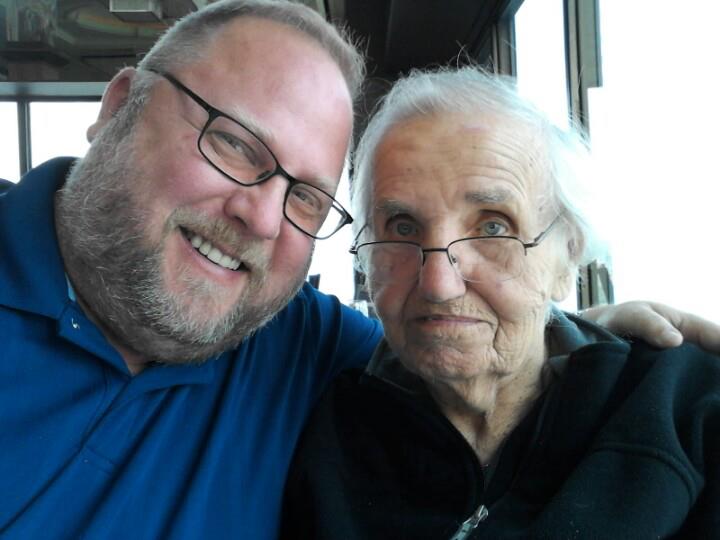
My grandmother and me in 2011. She would be very happy with my weight loss.

My grandmother used to have a saying: We should eat to live, not live to eat. When she would tell me this, I thought I understood what she was saying, but it seemed a little unrealistic to me. I was a person who not only loved food, I lived it. I would finish one meal and begin planning for the next. I would eat not due to stress, but because the act of eating was something I loved. I was the epitome of “Live to eat.”

Almost a year ago, I took the first steps to reversing that toxic lifestyle and changed my relationship with food. I went from being a person who lived to eat to being a person who eats to live. The change was monumental.

In the beginning, it was tough. I was one of those people who used to say, “I could never give up bread, pasta, beans, or rice.” I had to learn quickly that those foods were out of my lifestyle. But more than that, I had to realize that I was eating three meals a day to fuel my body and for no other purpose. That didn’t mean that my food had to taste horrible or bland. It just meant that I would eat only the amount of food needed to fuel my body, and only foods that were good for my body. Nothing more.

This was tough. It took as much mental discipline as it took me to get through USMC boot camp. However, something strange happened: I was able to adapt to it rather quickly.

I found that I was no longer hungry between meals. I felt sated and energized after meals instead of feeling sluggish and tired. I could do things during the day without thinking about what my next meal would be, not because I was hungry, but because I used to look forward to the next meal as a way to entertain myself.

As I drove home last night, I thought about the fact that my days are now filled with so much more than a preoccupation with food. My mind isn’t beholden to the food I eat, nor is it constantly thinking about food. When it’s meal time, I look forward to eating and I enjoy delicious foods, but it’s not the center of my universe anymore.

Like a toxic interpersonal relationship with someone, a toxic relationship with food can make life miserable. The best course of action when you’re in a bad relationship is to cut them out of your life. I had that sort of relationship with high-carb foods and sugar. It was hurting me on a regular basis, and eventually was going to kill me. I was able to change my relationship with food by engaging good foods instead of those that were out to kill me, and now, my life couldn’t be happier.

My Paleo Eat/Not Eat Cheat Sheet

This is sort of my cheat sheet when it comes to what I do and don’t eat:

DO Eat

  • Beef
  • Chicken
  • Pork
  • Fish
  • Vegetables
  • Fruits
  • Nuts

DON’T Eat

  • Grains
  • Beans
  • Dairy
  • Soy
  • Anything with added sugar
  • Anything pre-processed

Simple!

Now, there are more complexities than that, but for a simple cheat sheet, the list above works well.

Living la vida Paleo

File_000 (4)Anytime someone finds out that my dietary needs are different than the “norm,” the first question I get is if I’m on a non-gluten diet. I typically answer no, but that my dietary needs restrict high-carbs, so I need to avoid the grains, beans, and dairy. That’s when the puzzled looks begin and the further questions come up: “Why?”

It is typically at this point that I have a snap decision to make: do I just say it’s a preference or do I tell them that it’s because I’ve adopted a Paleo lifestyle and I no longer eat high-carb foods. I most often go with the latter which opens up the conversation for a whole bunch of questions: “What is Paleo?” “Why do that?” “How can you live without rice, beans, bread, pasta, etc?” And so on.

I try to stress to people that I’m not suffering, that I’m not eating bland foods, and that not only did I lose a lot of weight, but since I feel so much better, all aspects of my life have improved. I also discuss the improvements in my health as evidenced by my last physical and doctor’s visit.

The overwhelming majority of people treat me with wonderment, as if I’m doing something incredibly difficult or that they could never imagine themselves doing. Only a very few people ask for more information or ask for links, addresses, book recommendations, etc. Of those few, I’m not sure how many follow through, but I am pretty sure that number is low as well.

The perception is that living the Paleo Lifestyle is somehow difficult or wrought with deprivation when nothing could be further from the truth. I’ve stated many times on this blog that the foods I eat are not only delicious, but satisfying and good for me. Since cutting out added-sugars, I no longer have cravings between meals. The overwhelming majority of the foods I eat are actually some of the most delicious foods I’ve ever had. They have the added bonus of being good for me!

Eating high-carb foods is a temporary or fleeting satisfaction that goes against the long-term goals I have for losing weight and staying healthy. I’m happy to be where I am, and I’m looking forward to where I’m headed (165 lbs). I’m getting close, and while the rate of loss has been fairly steady, the actual lbs lost has dropped. This only makes sense because there’s less of me!

Living the Paleo Lifestyle is easier than you think and doesn’t put a damper on my enjoyment of food. On the contrary, I now taste so many more flavors vividly since cutting out added sugars and eating more natural and whole ingredients. Since I only eat to fuel my body, I don’t feel sluggish or tired after meals, and the improvements in my health have greatly increased my standard of living. If I’m doing any suffering, I haven’t yet found where. I don’t miss sweets, breads, pasta, and grains as much as I thought I would. In fact, I don’t crave them at all, and I haven’t in nearly a year.

Don’t let anyone fool you: this is completely do-able and sustainable long-term. It’s a lifestyle that contains lots and lots of food you’re already used to eating with some ingredient swaps that allow you to eat foods that are just like other foods you enjoy. This is the good life.

Finding Paleo-friendly Restaurants

My friend Kenny and I were looking for a place to eat lunch together on Sunday and he mentioned to me that in his experience, it’s always a safe bet to find Paleo food at a steak house or Mexican restaurant, but he didn’t know what else was really available to us. I mentioned that we can also find Paleo-friendly foods at Mediterranean restaurants, seafood places, and Japanese restaurants to name a few.

We settled on Mediterranean and found a Turkish restaurant. The entire menu was quite Paleo-friendly with the exception of the rice and breads. We were able to order a salad with cucumber, red pepper, onions, tomato, and oil and lemon juice that was exceptionally delicious and refreshing. The second part of our lunch was kofta kebabs served with fries (yeah, not the most Paleo of foods, but the fries there were actually very lightly oiled and cooked in a pan). We also both ordered an appetizer because the main courses were VERY small, and I ordered liver that was cut into small pieces and grilled in a pan. These foods were all very tasty and filling. I left there satisfied and really feeling good.

Eating at restaurants as a Paleo adherent is inevitable, so you need to have a plan and stick to it. Don’t accept non-Paleo options: most restaurants can make Paleo-compliant meals for you without much extra effort.

I’ve found that nearly every restaurant can grill a piece of meat and also grill some vegetables. This is my go-to when they have nothing that I can eat. Otherwise, it’s pretty easy to find foods that are Paleo compliant: just look for those foods that you can picture or imagine all the ingredients of. It’s always okay to ask your server if there is any sugar in the food. Sometimes if they ask if I’m diabetic, I just say yes (because I was!) and they find out from the kitchen. I’ve been surprised more than a few times with finding out that sugar was, in fact, in a savory food.

The meat-centered dishes I’ve found that I can eat at restaurants are:

  • Steak
  • Grilled shrimp
  • Rotisserie or grilled chicken from Taco Cabana or El Pollo Loco
  • Sausage (as long as it’s no-sugar added)
  • Brisket
  • Pulled Pork (I ask if the rub had sugar in it)
  • Grilled fish
  • Lobster
  • Crab
  • Fajitas (chicken and beef)
  • Grilled chicken breast (Lupe Tortilla has a great Chicken Lupe)

Notice that the chicken breast is at the bottom of the list. Almost any restaurant will have a piece of chicken somewhere, and as a last resort, you can have them grill one. I haven’t had to resort to this yet, but I almost did twice. It was an option I was glad I didn’t have to take.

As for vegetables, as long as you stay away from grains and beans, you can have anything. Most restaurants will have some sort of vegetables. They may not be the one you want, but it’s always better than the high-carb options most places use.

Good luck on your next trip out to eat! Let us know what you find, or what your experiences have been with eating Paleo in restaurants.

Paleo on a budget

I talk to a lot of people about the Paleo lifestyle, and I’ve been asked by a few folks whose budgets are tight about how viable and sustainable the Paleo lifestyle is when you don’t have a lot of money to spend on food. It’s not a concern that I take lightly. It’s a sad fact of life today that good, whole foods are more expensive than eating fast food. It is for this reason that the US is in the midst of an obesity epidemic. Just from an economic standpoint, it makes sense for the common person to eat fast food.

My wife and I are cost conscious when buying our ingredients. While it may not be the first factor in making our selections, it is most likely a definite second. We shop sales every week, and tailor our menus to what we can find on sale at the local food stores. This past week, for example, the local Kroger had brisket on sale for $.99/lb. That’s a great price for a whole lot of meat. They also had pork shoulder on sale for $.69/lb and ribs for $.99/lb. We ended up buying some brisket and ribs to smoke as it’s good for a few weeks afterward if stored properly.

Vegetables are seasonal, and as such, their prices vary on their availability. We tend to follow the seasonal norms for vegetables and fruits to keep the costs down. When purchasing seasonal vegetables, it’s also nice because they tend to be fresher and more ripe than off-season vegetables.

Pork and chicken can be inexpensive, and these can be quite tasty. The only real danger here is that these are bland meats that, if not prepared with spices and vegetables, can become boring and drive people away from eating well.

As for organic vs non-organic, if it’s simply a matter of economics, it’s hard to justify organic. From a nutritional level, non-organic whole food will always be better than pre-processed or fast food. Always. Also, organic will be better than non-organic, but this is a matter of pesticides, hormones, and fertilizers that have lingering presence in the fruits or vegetables once they are consumed. I recommend buying organic when it’s possible, but if it’s just too expensive, go with the non-organic versions. You’re still far better off.

The final point I’d like to make is that when you make your own food, you tend to waste less. The food goes quite a long way if you save leftovers and use them for lunches or additional meals. While sometimes a cut of meat may seem expensive, when we consider how many meals or servings we get out of that meat, it really shows how cost effective eating well can be.