Living with a stress eater

20171110My wife is a stress eater. She has been all her life, by her own account. When she is under a heavy load of stress, whether it’s at work or otherwise, she takes solace in eating sweets. This has been one of her biggest challenges since doing our first Whole30, and is why I wrote an article about recommending a low-stress time in one’s life before starting a lifestyle change like Whole30, Paleo, or keto.

I’m not a stress eater. I am a stress hobbyist. The more stress I’m under, the more I bury myself in hobbies or video games. We all cope with stress in different ways, and I’m not saying that being a stress eater is wrong. As my sister would say, it is what it is.

With that said, I’ve learned some things I can do to help my wife when she’s under a lot of stress. First and foremost, if I do see her eating something that she shouldn’t be eating or wouldn’t normally eat, I ask her about her day. I ask her what’s going on. I don’t ever point out that she’s eating anything off-plan. Well, I try not to, and I may have given a look or raised an eyebrow, but I try not to call her out on it. I know she wouldn’t be eating that unless something is eating at her.

Second, I try to do what I can to alleviate her stress as best I can. I know I have no ability to reduce her work stress, but I can offer advice or tips I use to reduce stress in the workplace. Outside of that, I volunteer to make dinner or I take her out for dinner to keep her from having to prepare food.

Third, I do what I can to get her away from the foods she normally wouldn’t be eating without making a big deal out of it. I ask her if she would like to take a walk, I go walk the dog with her, or I go to her and just talk and let her vent. These things seem to help.

Ultimately, it’s her body, her appetite, and her stress. I am not her food police, and I don’t judge her for what she eats or drinks. I want her to be happy, first and foremost, and if that involves eating or drinking something off-plan to get her through a stressful time, so be it. It only would become a problem if it became a day-in/day-out eating pattern. At that point, I’d speak up.

The most important skill my wife and I have learned since undertaking our first Whole30 has been to be mutually supportive. It is rare that she and I are on the same upswing of motivation. Usually, one of us needs some support, and that’s when the other half steps up and carries the other. Everything, from making breakfast in the morning (first one in the kitchen starts it) to making coffee and rubbing a back in an afternoon after work. Ultimately, we operate as a team, and together, we succeed. Living with a stress eater is just another challenge in the big picture, but it doesn’t have to be the one that defines you (or them). There are ways to cope and mitigate, and together, we’ve been doing a good job of that.

When a Whole30 Fails

I have heard from more than a few people that they successfully completed a Whole30, yet didn’t lose any weight. Some complained that they didn’t feel any better, or that it didn’t do for them what they thought it would, yet they fail to really look at why they didn’t see the same type of results Sherry or I did. What’s worse is many avoid confronting their own choices while on Whole30 to try to isolate why it wasn’t successful for them.

Something very telling to me was when someone who didn’t lose any weight on their Whole30 asked me about Keto. When I told them about it, they said, “Oh, I could never do without my fruits.” I asked this person who just completed their Whole30 how many fruits they ate during the Whole30. “Two or three bananas a day as snacks, and some fruit with each meal.” They said that since fruit is allowed and even recommended on a Whole30 that they stuck to it to the letter, and that anything more restrictive would not work for them.

Ahem.

Whole30 is supposed to, among other things, help you break your addiction to sugar. Bananas and many fruits are filled with lots of sugar. The Whole30 I followed was very light on fruit. As a matter of fact, I avoided them altogether. Why? Because I read enough about low-carb diets that I knew that I needed to get there. I knew it was going to be uncomfortable and difficult for the first week or two, but that the discomfort would be worth it to reap the benefits of breaking my addiction to sugar.

Another thing that I hear a lot from people who were unsuccessful on their Whole30’s was that they ate as much as they wanted to. Once again, this is not in keeping with Whole30. Portion control isn’t a primary goal, but you are supposed to eat more reasonably. What does that mean? If you make a cup with both your hands, your dinner should be able to fit in it. Seriously. Yes, it’s a little difficult to get used to in the beginning, especially if you ate the way I used to eat when I was morbidly obese: I was all about eating lots of food. But that was part of my problem (along with the sugar addiction). Volume is important. A lot of food, even if it’s good food made from whole ingredients, will still carry a lot of calories. Too many calories will always keep you from losing weight.

If you did a Whole30 and it didn’t give you the results you were looking for, take a long hard look at what you did, how you did it, and where you went wrong. It’s not an indictment, and I’m not judging you. It’s a tough diet to get through, and for those who have serious eating issues or a strong sugar addiction (like I did) will find it very restrictive, but the rewards are worth the discomfort and difficulty. Once you get past the first week, life gets better. Just stick to the plan and reduce the carbs and portion sizes and try again.

Daily Meals on Keto

IMG_8609In my Keto experiment, my meals have been quite similar to my Paleo meals except with a focus on more fat and fewer carbs. WAY fewer carbs.
Breakfast is pretty similar: two slices of bacon, two eggs sunny-side up, and a slice of a cinnamon keto bread that Sherry made. Coffee with exogenous ketones was added early on to help transition into keto, but I stopped that after a week or so as I no longer needed them.

IMG_1227

Lunch: Typically a low-carb meal made by Sherry. Many of these were old Paleo recipes that she adapted by eliminating tomatoes, onions, and/or honey (which was used very rarely, but still). There are many examples of these on her blog.

IMG_1293

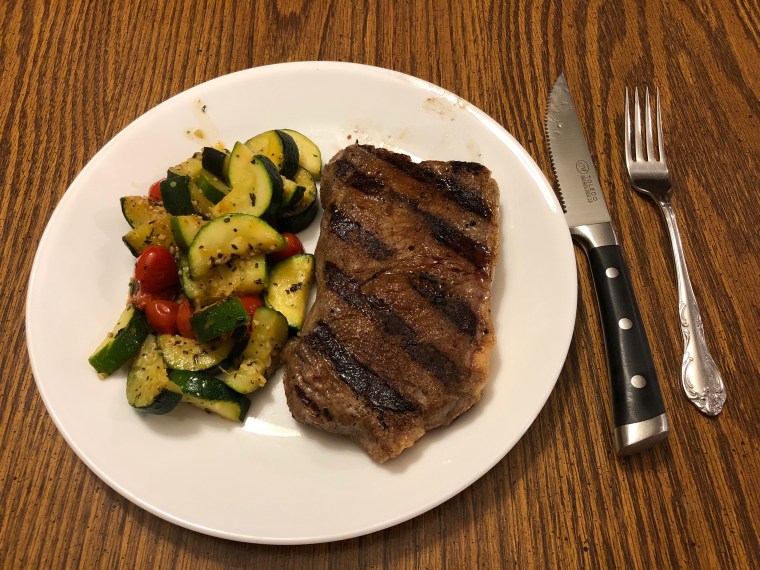
Dinner: We ate a lot of the normal foods that we typically ate on Paleo: steak, ribs, nitrate and sugar-free sausage, and fish, except we substituted sweet potatoes and onions for things like asparagus and a lot of cauliflower.

I had planned to be more detailed and do things like weigh my food and calculate grams of carbs, but honestly, that’s the side of keto that I’m not enamored with. I like the simplicity of Paleo: eat good and healthy foods made from whole ingredients. Eat them until you are satisfied but not stuffed. It has been working for me for two and a half years, and I feel good with what I accomplished on keto but I am happy to be adopting my keto/Paleo hybrid lifestyle.

Modifying our Keto

img_1428It was successful, and I got out of it what I wanted to get out of it; some weight loss and another experience with getting into ketosis (but this time using exogenous ketones) and staying in ketosis. I learned about how to eat at restaurants and the differences in preparing keto food vs Paleo food. What I decided, through a lot of conversations with my wife along the way, is that we’re going to adapt to a combination Paleo-Keto diet.

We enjoy the cheeses. We enjoy sour cream and cream cheese, but we both are lactose intolerant and get bloated/puffy when we eat anything with lactose in it. Worse, I experience digestive distress and can guarantee a violent trip to the restroom within 30 minutes if I eat anything with too much lactose in it. So, that’s a limitation for us. Also, we don’t want to overdo cheeses; just to have the option of using them.

My wife prefers natural sweeteners like honey or agave. I agree that they taste better, but I don’t have the visceral negative reaction to the use of erythritol or other artificial sweeteners in food if used in moderation. We will likely stick to more natural sources of sweetness in small amounts, but making something with artificial sweeteners will be an option now (but again, we aren’t going to lean on it).

Root vegetables: carrots, onions, sweet potatoes, and even others like tomatoes and green peppers will remain in our quiver of available food items. On keto, these are frowned upon due to their carb count, but while Sherry and I have been living LCHF for the past two and a half years, I think our version of LCHF has been moderate. With that said, it’s also been wildly successful, so it can’t be all bad.

Otherwise, I will continue to eat our Paleo/keto foods. Or is it keto/Paleo? I think the latter follows more traditional convention of alphabetical order, but I digress. This keto/Paleo plan is a solid one, I think, and I will be documenting our discoveries and experiences, including good and bad and everything in between.

I think keto is still a great way to get into serious weight loss, and I did feel energized in the mornings and a mental clarity that I hope I don’t lose, but it is too restrictive for our active lifestyles that includes a lot of travel. We also enjoy eating new foods at the places we visit, and being in ketosis severely limits our ability to have a one-off meal here and there easily and without causing a lot of extra effort for us to get back into ketosis. Some would say that we’re being lazy or making too much out of it, but at this point, we’re convinced of the efficacy of the diet we’ve been on for the past two and a half years as evidenced through our combined 215 lbs of weight loss (150 lbs for me, 65 lbs for her).

One of the neat things about this journey has been finding what works and discovering what doesn’t (and discarding or limiting them). There is no one-size-fits-all diet for everyone. I can recommend a starting point for you, but it’s up to you to closely monitor and watch how your body responds to the different foods to adapt your diet to your body. That’s what Sherry and I did with keto/Paleo, and so far, we’re enjoying the benefits in our health and the flavors on the table.

Clear the Itinerary when Starting

IMG_1600I’ve given advice before about when to start a Whole30, Paleo, or keto, but what I didn’t discuss was what goes into your decision to select a start date. There is more to it than just using what’s in your refrigerator or pantry, and stocking up with tupperware or food to prep. There’s more to it than putting together a menu of items to make. There’s emotional stability.

I have discussed what I believe to be the biggest factor in success in any diet: mindset. It takes a lot of determination and setting goals and limits before you even take your first bite of a new diet. Adopting a lifestyle and not accepting failure and not allowing sabotage (what people call cheating on a diet) to happen. These are all important as well, but even if you have the best intentions, made appropriate preparation, and have all the ingredients, you still need to do one very important thing: make sure your life isn’t in turmoil.

Changing your lifestyle and adopting a new diet is very stressful in and of itself. You are changing your relationship with food which is one of the most intimate relationships we have. It can be, and will be quite stressful even in the best of conditions. Trying to take on this stress while going through a stressful time in your life will force you to try to extricate yourself from any stress you can, and your diet and new lifestyle will be the easiest to rectify. Thus, you’re setting yourself up for failure.

Do yourself a favor: make sure your life is in order and things are going well enough that you can take on something like a new diet and lifestyle before you jump in. My wife had a very hard time with doing keto while going through some stressful times at work, and it became very difficult for us to continue together even with the mutual support system we’ve developed. I can only imagine what it would be like trying to go through it alone or without a supportive partner.

Sacrifice for Health

paleomarinecomimages_6_original_bueenboc3zkI’ve heard people say they would do anything for their kids, their spouse, or their friends, but do they really mean it? One of the most special gifts we can give our loved ones is our time, and spending it with them is special, indeed. We limit our available time when our health is poor, as our lifespans are reduced. Why then do we not consider that improving our health actually benefits not only us, but also our loved ones?


That brings us to sacrifice which is giving up something at a cost to our comfort, safety, or giving up something important to us for the benefit of others. Most people view sacrifice as something to be avoided until the last possible chance. Why sacrifice when there is not much pertinence to it? That’s why so many people don’t start doing something about their health until they’ve been told by a doctor that their life depends on it.

Sacrifice doesn’t have to be something that makes you miserable. Sacrifice can be just giving up something like pizza, bread, pasta, and alcohol. For some, this may seem like a sacrifice at first, but as you get used to it, you realize how silly it was to think that not eating certain foods would affect the quality of one’s life so much. In reality, giving up some of my favorite foods has made my life richer, fuller, and healthier. I am now able to do things I never dreamed of doing when I was 40, let alone now that I’m 50. I sacrificed pizza, pasta, bread, and alcohol for a better life, and possibly a longer and healthier one, too. I call that a fair trade.

Think about your priorities. I mean really think about them. If certain foods and/or alcohol are a priority to you, perhaps there’s a bigger problem you should be looking at. There is no reason to stick to foods that work against your good health and cause you to gain weight, and there’s definitely no reason to rely on alcohol to get you through the day.

I sacrificed, and I am better for it. I sacrificed not only for myself, but for my wife, my kids, my family, and my friends. I sacrificed and in the end, didn’t feel like I really gave up anything of value at all. It’s like a cheat code to life that requires some up-front uncomfort, but it pays off with a richer, fuller, and healthier life.

Majority of America’s Young Unable to Serve due to Excessive Weight?

simplyhdr56141990-1
This 50 year-old soldier is healthier than 71% of America’s youth.

A story on Military.com about the Army’s desire to change its culture of health and fitness had a frightening statistic in it.

A recent Heritage Foundation report found that, according to 2017 Pentagon data, “71 percent of young Americans between 17 and 24 are ineligible to serve in the United States military.” Nearly one-third of those young Americans are too overweight for military service.

“Put another way: Over 24 million of the 34 million people of that age group cannot join the armed forces — even if they wanted to,” said retired Lt. Gen. Thomas Spoehr and Bridget Handy, who authored the report, “The Looming National Security Crisis: Young Americans Unable to Serve in the Military.”

As a soldier and a former active duty Marine, this frightens me. This is the pool from which my future troops will come from, and unless something changes, the Army will have to do one of two things: lower recruitment standards to allow overweight recruits into the Army and then have to work to get them into height/weight standards, or find a way to do what we are tasked with doing today with fewer people. The latter is untenable. The former may be the only solution.

What I don’t understand is why the Army doesn’t address the problem in basic training by teaching recruits to eat properly. Afterall, getting them fit is easy, but getting them to lose weight to improve their health won’t happen on the current diet that is fed to recruits: high carb, low fat. It’s actually the exact opposite of what would help these young Americans be able to serve their country.

The Height of Rudness

mehTelling an overweight person to eat less and move more is exactly like telling a person who suffers from depression to cheer up. It’s literally just that bad. I heard someone today tell an overweight person to just eat less and move more today, and the look on the girl’s face said it all; she was embarrassed and hurt. I interjected and told the person offering the advice that there was a lot more to it than that, and that it really isn’t anyone’s business but their own. They tried to laugh it off, but really, it’s no laughing matter.

People used to give me this advice all the time when I was obese, and it felt so insulting, embarrassing, and made me feel like a failure. Of course eating less would really help me lose weight.  I felt like I had failed life, that I had failed on fulfilling one of the most basic human needs properly: eating enough, but not too much. I had tried so often and failed, and yet here are all these people who somehow were keeping it together, eating food, and staying thinner than I was. I obviously didn’t know what I was doing.

The problem is that we aren’t taught the right way to lose weight easily and safely, and it seems so out of reach for those of us who are obese. Low-carb/High-fat (LCHF) was the method I found that worked for me. There are many ways for people to get healthy and to lose weight, and I implore you to find what works best for you. I hope that the rude people don’t discourage you and don’t keep you from finding the path that leads you on your own journey to good health. It’s so worth it. You’re so worth it.


What makes it hard?

preppedThere are some things I will admit are not easy to do when adopting the Paleo Diet, a ketogenic diet, or doing a Whole30. They are:

  1. Food prep. This is a big one, and may be the biggest obstacle for most people I talk to. The concepts of eating low-carb/high-fat is easy enough, and while it’s something a lot of people don’t really want to do, it’s something they eventually recognize they have to do. However, to stay on the straight and narrow, it requires more work than the standard American diet. You can’t just go to any fast food restaurant and order Paleo or keto-friendly foods without some picking and choosing and possibly even modifying. So, food prep is a way of life. It can be as easy as using two or three slow cookers and an oven to prep to actively cooking three or four meals which can take all day. My wife does our food prep on Sundays; some days are fast and easy while others keep her (and I) on her/our feet all day. It just depends on how dandy we want our food to be, and whether the food requires a lot of steps or is as easy as smoking a rack of ribs.
  2. Purchasing foods and getting used to looking closely at labels. This is another obstacle to eating well: shopping and reading. It requires a certain vigilance to really find the forbidden ingredients in foods. Did you know they put soy in tuna fish? Or most sausages and even bacon have sugar in them? These foods can do without those ingredients, yet they’re placed there by food makers. Sherry and I read every label of every food item we purchase that has been even slightly processed like sausage or bacon. We try to stick with whole meats and vegetables, but there are times when some Italian sausage or a chorizo is what a recipe needs, so we have to find the best/healthiest version. Also, sticking with healthy, whole foods can seem to be more expensive, but when you consider that you actually eat less volume of good, whole foods, it ends up not only not being more expensive, but can actually save money in the long run.
  3. Whole30/Keto Flu. This is a big one for anyone who is going from the standard American diet to a low-carb diet. The symptoms can last from 1 day to 2 weeks depending on how much sugar a person used to consume in their diet. The symptoms can be reduced when adopting a ketogenic diet by taking exogenous ketones, but when going Paleo or doing a Whole30, the only way through it is to bear down, use as much motivation as possible, and eat a handful of nuts every now and then to get past the cravings. After a few days to a few weeks, it will improve, and the cravings will disappear.
  4. Changing your mindset and accepting that you don’t have to be suffering to get healthy and lose weight. This was difficult for me to get past. As I was losing 10-12 lbs/month without suffering, I thought I was doing something wrong. Even as I was succeeding, I felt like I wasn’t doing enough. I felt like I somehow should be doing more, eating foods that weren’t as tasty or that didn’t make me feel so full. I never counted calories yet I ate delicious foods, felt full after meals, and didn’t have cravings in between them. Because I was so conditioned to suffering for weight loss, I felt guilty the whole time. I took almost a year for that feeling to go away.
  5. Other people. Some offer advice when they don’t understand the low-carb/high-fat diet. When people see me eating a meal with meat, bacon, fats, and such, they tell me I should really watch what I’m eating or I’ll gain weight. They don’t understand that it’s that very food that has allowed me to lose over 150 lbs and regain a healthy life. They mean well, so I’m never hostile about it, but when I try to explain to them that I know what I’m doing, some persist. Some have gone so far as to tell me that I’m wrong, and that I’ll gain all the weight back and then some. A smaller percentage are jealous of my success, and have tried to either sabotage me or have decreased contact with me because of how my success makes them feel about their own failures. It’s okay; I know it’s them, and not me.

I’m sure there are other difficulties that people face, but these were my top 6. With all that said, however, I can’t say enough about the improvements in my life since adopting LC/HF. I’ve posted many times in the past about the ways in which my life has improved and changed, and I can’t ever let myself go back to being overweight, let alone obese.

People Will Understand

file (2)A lot of people find themselves in situations where everyone is imbibing alcohol or high-carb foods at social events, and they feel pressured to partake. When I was on Paleo, that wasn’t typically such a big deal; my body could handle a meal and a little alcohol with aplomb, and recovery time was typically pretty light. On keto, however, this can be more problematic. One glass of an alcoholic beverage coupled with a slice of pizza can throw my body out of ketosis and force me to have to work on getting back into ketosis that could take up to a week.

How do you tell people that you don’t want that glass of beer or that slice of pizza? I’ve found it to be pretty easy: I just politely say, “No, thank you.”

You may get a few quizzical looks or a question about why, but typically, polite people smile and move on to the next person. In rare cases, I’ve been asked more specifically if I’m on a certain diet or if I have some health issue precluding me from imbibing what’s being offered, and depending on who is asking and the setting, I’ll either just say, “No, thank you,” or I’ll explain that I’m on a diet that restricts the type of food I’m on. If they persist and ask why, I will reply with, “For my health.” And I leave it at that.

I’ve not had anyone really get upset or feel insulted, contrary to what I expected when I first started eating well. I have been very surprised with how understanding and supportive most people are, and on the rare occasion when someone doesn’t truly understand, I just smile and let the awkward silence tell it all.

Don’t feel forced to eat bad food. Don’t feel like a social situation makes it imperative for you to eat foods you don’t want to eat, or drink what you don’t want to drink. It’s ultimately up to you, within your power, and you are armed with the words, “No, thank you.”