
My Paleo Eat/Not Eat Cheat Sheet

This is sort of my cheat sheet when it comes to what I do and don’t eat:

DO Eat

  • Beef
  • Chicken
  • Pork
  • Fish
  • Vegetables
  • Fruits
  • Nuts

DON’T Eat

  • Grains
  • Beans
  • Dairy
  • Soy
  • Anything with added sugar
  • Anything pre-processed

Simple!

Now, there are more complexities than that, but for a simple cheat sheet, the list above works well.

Living la vida Paleo

File_000 (4)Anytime someone finds out that my dietary needs are different than the “norm,” the first question I get is if I’m on a non-gluten diet. I typically answer no, but that my dietary needs restrict high-carbs, so I need to avoid the grains, beans, and dairy. That’s when the puzzled looks begin and the further questions come up: “Why?”

It is typically at this point that I have a snap decision to make: do I just say it’s a preference or do I tell them that it’s because I’ve adopted a Paleo lifestyle and I no longer eat high-carb foods. I most often go with the latter which opens up the conversation for a whole bunch of questions: “What is Paleo?” “Why do that?” “How can you live without rice, beans, bread, pasta, etc?” And so on.

I try to stress to people that I’m not suffering, that I’m not eating bland foods, and that not only did I lose a lot of weight, but since I feel so much better, all aspects of my life have improved. I also discuss the improvements in my health as evidenced by my last physical and doctor’s visit.

The overwhelming majority of people treat me with wonderment, as if I’m doing something incredibly difficult or that they could never imagine themselves doing. Only a very few people ask for more information or ask for links, addresses, book recommendations, etc. Of those few, I’m not sure how many follow through, but I am pretty sure that number is low as well.

The perception is that living the Paleo Lifestyle is somehow difficult or wrought with deprivation when nothing could be further from the truth. I’ve stated many times on this blog that the foods I eat are not only delicious, but satisfying and good for me. Since cutting out added-sugars, I no longer have cravings between meals. The overwhelming majority of the foods I eat are actually some of the most delicious foods I’ve ever had. They have the added bonus of being good for me!

Eating high-carb foods is a temporary or fleeting satisfaction that goes against the long-term goals I have for losing weight and staying healthy. I’m happy to be where I am, and I’m looking forward to where I’m headed (165 lbs). I’m getting close, and while the rate of loss has been fairly steady, the actual lbs lost has dropped. This only makes sense because there’s less of me!

Living the Paleo Lifestyle is easier than you think and doesn’t put a damper on my enjoyment of food. On the contrary, I now taste so many more flavors vividly since cutting out added sugars and eating more natural and whole ingredients. Since I only eat to fuel my body, I don’t feel sluggish or tired after meals, and the improvements in my health have greatly increased my standard of living. If I’m doing any suffering, I haven’t yet found where. I don’t miss sweets, breads, pasta, and grains as much as I thought I would. In fact, I don’t crave them at all, and I haven’t in nearly a year.

Don’t let anyone fool you: this is completely do-able and sustainable long-term. It’s a lifestyle that contains lots and lots of food you’re already used to eating with some ingredient swaps that allow you to eat foods that are just like other foods you enjoy. This is the good life.

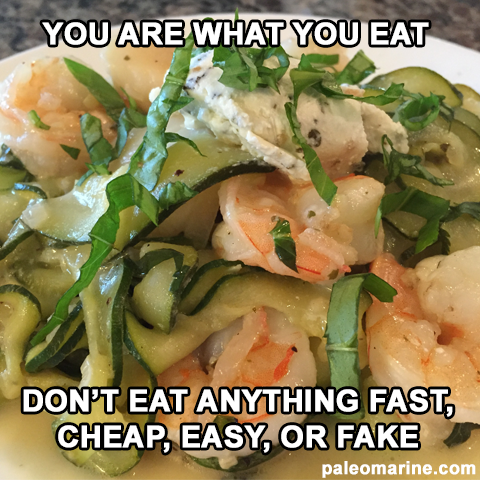
Finding Paleo-friendly Restaurants

My friend Kenny and I were looking for a place to eat lunch together on Sunday and he mentioned to me that in his experience, it’s always a safe bet to find Paleo food at a steak house or Mexican restaurant, but he didn’t know what else was really available to us. I mentioned that we can also find Paleo-friendly foods at Mediterranean restaurants, seafood places, and Japanese restaurants to name a few.

We settled on Mediterranean and found a Turkish restaurant. The entire menu was quite Paleo-friendly with the exception of the rice and breads. We were able to order a salad with cucumber, red pepper, onions, tomato, and oil and lemon juice that was exceptionally delicious and refreshing. The second part of our lunch was kofta kebabs served with fries (yeah, not the most Paleo of foods, but the fries there were actually very lightly oiled and cooked in a pan). We also both ordered an appetizer because the main courses were VERY small, and I ordered liver that was cut into small pieces and grilled in a pan. These foods were all very tasty and filling. I left there satisfied and really feeling good.

Eating at restaurants as a Paleo adherent is inevitable, so you need to have a plan and stick to it. Don’t accept non-Paleo options: most restaurants can make Paleo-compliant meals for you without much extra effort.

I’ve found that nearly every restaurant can grill a piece of meat and also grill some vegetables. This is my go-to when they have nothing that I can eat. Otherwise, it’s pretty easy to find foods that are Paleo compliant: just look for those foods that you can picture or imagine all the ingredients of. It’s always okay to ask your server if there is any sugar in the food. Sometimes if they ask if I’m diabetic, I just say yes (because I was!) and they find out from the kitchen. I’ve been surprised more than a few times with finding out that sugar was, in fact, in a savory food.

The meat-centered dishes I’ve found that I can eat at restaurants are:

  • Steak
  • Grilled shrimp
  • Rotisserie or grilled chicken from Taco Cabana or El Pollo Loco
  • Sausage (as long as it’s no-sugar added)
  • Brisket
  • Pulled Pork (I ask if the rub had sugar in it)
  • Grilled fish
  • Lobster
  • Crab
  • Fajitas (chicken and beef)
  • Grilled chicken breast (Lupe Tortilla has a great Chicken Lupe)

Notice that the chicken breast is at the bottom of the list. Almost any restaurant will have a piece of chicken somewhere, and as a last resort, you can have them grill one. I haven’t had to resort to this yet, but I almost did twice. It was an option I was glad I didn’t have to take.

As for vegetables, as long as you stay away from grains and beans, you can have anything. Most restaurants will have some sort of vegetables. They may not be the one you want, but it’s always better than the high-carb options most places use.

Good luck on your next trip out to eat! Let us know what you find, or what your experiences have been with eating Paleo in restaurants.

Paleo on a budget

I talk to a lot of people about the Paleo lifestyle, and I’ve been asked by a few folks whose budgets are tight about how viable and sustainable the Paleo lifestyle is when you don’t have a lot of money to spend on food. It’s not a concern that I take lightly. It’s a sad fact of life today that good, whole foods are more expensive than eating fast food. It is for this reason that the US is in the midst of an obesity epidemic. Just from an economic standpoint, it makes sense for the common person to eat fast food.

My wife and I are cost conscious when buying our ingredients. While it may not be the first factor in making our selections, it is most likely a definite second. We shop sales every week, and tailor our menus to what we can find on sale at the local food stores. This past week, for example, the local Kroger had brisket on sale for $.99/lb. That’s a great price for a whole lot of meat. They also had pork shoulder on sale for $.69/lb and ribs for $.99/lb. We ended up buying some brisket and ribs to smoke as it’s good for a few weeks afterward if stored properly.

Vegetables are seasonal, and as such, their prices vary on their availability. We tend to follow the seasonal norms for vegetables and fruits to keep the costs down. When purchasing seasonal vegetables, it’s also nice because they tend to be fresher and more ripe than off-season vegetables.

Pork and chicken can be inexpensive, and these can be quite tasty. The only real danger here is that these are bland meats that, if not prepared with spices and vegetables, can become boring and drive people away from eating well.

As for organic vs non-organic, if it’s simply a matter of economics, it’s hard to justify organic. From a nutritional level, non-organic whole food will always be better than pre-processed or fast food. Always. Also, organic will be better than non-organic, but this is a matter of pesticides, hormones, and fertilizers that have lingering presence in the fruits or vegetables once they are consumed. I recommend buying organic when it’s possible, but if it’s just too expensive, go with the non-organic versions. You’re still far better off.

The final point I’d like to make is that when you make your own food, you tend to waste less. The food goes quite a long way if you save leftovers and use them for lunches or additional meals. While sometimes a cut of meat may seem expensive, when we consider how many meals or servings we get out of that meat, it really shows how cost effective eating well can be.

You are what you eat


Supplements, additives, pills, etc

I’m a firm believer that all a person needs to do to get healthy and to lose weight is to eat natural foods without overindulging. I’m not even saying no carbs: just avoid high-carb foods. The reason I’m a firm believer is because within 10 months, I lost over 100 lbs. I did that without any pills, supplements, vitamins, surgery, drugs, or any other method used to put chemicals into the body. I did it naturally.

I know people who use certain products in their quest to become healthy. I personally believe that these products aren’t really necessary, but for some people, it seems to help. Some of these products claim to reduce hunger or give people energy, but in my experience, if you cut out high-carb foods and anything processed with added-sugar, those things happen naturally. If the foods you eat are natural, they will contain lots of nutrients and vitamins that will keep you full and give you energy. You will find yourself n not hungry between meals unless you ate a light meal.

Exercise, done smartly, is beneficial all around. As long as you’re careful and don’t overdo it, I recommend it. I don’t do any crazy difficult exercise regimen, but I do use kettle bells and walking to get the muscles moving and in shape.

I can’t say the same for the diet industry. I haven’t seen any neutral third party scientific evidence that supports the assumption that these products aid in the loss of weight. Further, in every one of the products, even in their own descriptions, they say “Coupled with a sensible diet and exercise…” Well, duh. If you do the sensible diet and exercise part without their product, guess what’s going to happen? You will lose weight.

Be smart and put good food into your body. Avoid sugar, processed foods, or high-carb foods. Get some exercise. Stick with this regiment for life. Only then will you see your weight drop and stay down.

Dedication to yourself

We all have different reasons for why we’re here. Some of us want to lose weight. For some, there’s a lot of weight to lose while for others, not so much. Then there are those who want to get healthy, or who want to eat more natural foods. All of these reasons are unique, and special, and valid. They all brought you here, and you took the first step in getting healthy and/or losing weight.

There are those of you who are already in, either doing or have done a Whole30 and are either going or have already gone to a Paleo lifestyle. That’s great! I look at other sites all the time to gain more insight, knowledge, tips, and tricks on how to live my life better.

It doesn’t matter to me what your motivation is. What matters is that you take this seriously and really dedicate yourself to getting healthy and/or losing weight. Don’t do it for my sake. I’ve lost a ton of weight and I’m healthier than I’ve ever been. I’m asking you to take it seriously for YOUR sake. This is all about you.

This is the convergence of all those reasons and motivations. This is the point at which we all come together and head into a common direction: to get healthy. The cost? Dedication.

I never said it was easy. I never said it was effortless. What it is, though, is satisfying. When you begin to feel better or start feeling your clothing get loose, it feels great. These are the payoff fr your dedication. You have no-one to thank but yourself. I may be an inspiration or help you with motivation, but ultimately, you have to do this for yourself.

You can do this.

Learning and Evolving in Paleo

For those who have never played any of The Sims computer games, please bear with me. According to Wikipedia:

The Sims is a life simulation video game series, developed by EA Maxis and published by Electronic Arts. It is one of the best-selling video games series of all time.

It’s fascinating how they have simulated personality types so well in the game. Growing up, my kids would often refer to other people based on the type of sim they were closest to: “Oh, that person is a family sim. That person is a money sim.” As for me, I’m a knowledge sim.  According to The Sims Wiki:

Sims with the Knowledge Aspiration want to know everything there is to know about anything. Make sure they have the time to study and explore every nook and cranny. Their lives are a simple equation: the more Knowledge, the higher the Aspiration Meter, and the longer and brainier the life.

I want to learn as much as I can on any topic, subject, or hobby that I’m taking an interest in. Whether it’s radio controlled aircraft, coin collecting, or military history, I read voraciously, trying to learn as much as I can. When it comes to nutrition and Paleo, I’ve been doing the same. It’s not just a hobby or a diet for me: it’s become my lifestyle and my passion.

With that aspiration to learn as much as I can comes the reality that sometimes I have to change an earlier misconception or correct the knowledge nugget in my head. One of these is referring to Paleo as no-carb or low-carb.

In reality, Paleo allows carbs, but it cuts out foods that are dense in carbs as a proportion to their mass. This is a huge distinction, as people who are knowledgeable about our body functions correctly assert that the human body runs off glucose which is most easily metabolized from carbs. However, this doesn’t mean our bodies are built to sustain the carb onslaught we put it through every time we eat grains and legumes. Our bodies, in their efficient form, try to get every bit of energy out of the carbs we eat. If we eat more than we need, our bodies store that in the form of lipids, also known as fat. By limiting our carbs to reasonable levels, our bodies won’t overproduce energy and will not be in a position to store it.

In earlier posts, I’ve written about Paleo being low-carb or non-carb. These are not correct phrases, and I will be eliminating them from my dietary vocabulary. Paleo limits carb-dense foods: this is true, but it does not eliminate carbs nor is it low-carb. It’s lower carb than the average American diet, to be sure, but I think the focus should be on eating foods that nutritionally make sense for us. Carb-dense foods just don’t fit into the logic of a balanced diet.

The importance of this change in terminology is huge: I find people are immediately turned off when they hear no-carb or low-carb, but when you talk about limiting carb-dense foods and replacing them with more reasonable carb content foods, people seem to find this reasonable and logical and can more easily consider adopting a lifestyle that will help them lengthen their lives, increase their quality of life, and even lose weight.

What is keeping you from committing?

What is keeping you from going all-in on your health? What are the reasons why you haven’t yet been able to change your lifestyle from the one you currently live on to one that is healthy and more sustainable? What logic have you been using to keep yourself from making a change that can lengthen your life and allow your quality of life to improve? Whatever these arguments have been, you need to take a hard, long look at yourself and really think about whether these reasons are beneficial to you and your goals in life.

Nothing worthwhile is easy.

I never said that getting healthy and losing weight is without effort. I did say it felt easy for me as compared to what my perception of how hard it would be was. Was it a cake walk? No (and man, I love cake!), but it wasn’t nearly as difficult as I made it out to be in my head. Just like anything, we build things up to be harder than they usually turn out to be unless we’re talking about a trek up Mount Everest: nobody expects it to be as hard as it turns out to be. Every time (and no, I haven’t done it myself, but I know people who have, and they all say the same thing, so I believe them).

I think the foundation upon which all objections to changing one’s lifestyle from whatever a person is eating now to one that is healthy and sustainable is based on their relationship with food. If you remove your love of pasta, bread, beans, rice, potatoes, etc, then it’s hard to argue the logic of eating foods that are not dense in carbs.

Until you can separate your love of foods from the decision required to accept the logic of eating foods that are healthier for you, it will be difficult, if not impossible, to change your lifestyle in a meaningful way. I say this from not only my own experience, but from what everyone I know who has been successful with Paleo has told me. People who struggle with Paleo or with doing a Whole30 have one thing in common: they have not come to grips with the relationship with food and haven’t made the long-term commitment to break up with those foods that are hurting them. Until you do that, you’re fighting an up-hill battle.