Picturing Sugar Cubes

sugarOrganic and Healthy doesn’t really mean that the food is good for you. While browsing the Organic and Healthy section of our local grocery store, I was once again dismayed at the lack of LCHF options. Almost every item was high in carbs: often 20g or more of sugar carbs per serving. That’s healthy?

One sugar cube is 4g of sugar. When reading labels, I picture sugar cubes as I translate the grams of sugar contained in a serving. What is amazing to me is when you see a package of “Healthy, Organic Cookies” and a serving has 37g of sugar, yet if you were to take sugar cubes, you could hardly fit them into the package the cookies are in. How do they cram so much sugar into a package?!?!?!

Another trick is that certain foods have very small serving sizes. I looked at a tiny container of some sort of “Healthy” food, and it was about 1.5 cups in volume, yet the label said it was 2.3 servings. Each serving was 160 calories with something like 12g sugar. That’s over 8 sugar cubes in that tiny container!

I should write an app that displays sugar cubes with augmented reality on the object containing the sugar so you can visualize the amount of sugar in the food item. I think it would be an eye-opening experience to see just how much sugar is in foods that shouldn’t have them.

Sabotage vs Slipping

paleomarinecomimages_19_original_bueenboc3zk(1)I felt it’s important for me to make a distinction between my last article and a concept I talk about from time to time: sabotage.

When I say it’s okay to have a slip every now and then, I meant that for a few reasons. One, there are people (like myself) who beat themselves up over it when it happens (and that’s not okay), and two, because life happens. A small slip, especially on a holiday, special occasion, or on a rare occasion, is not the end of the world. It’s not a great thing, but it’s okay. You will get past it, and you will continue to make great strides toward better health and (if it’s your goal) a lower weight.

However, what is NOT okay is to make it a regular acceptable occurrence. This is what many people refer to as Cheat Days, or Cheat Meals. I see them as sabotage days or sabotage meals, because when you are on a LCHF diet, especially on Keto, one cheat meal can completely sabotage your progress for weeks. Why would you work so hard and then give it all back in a single day, or even in a single meal? That makes no sense to me.

Back to my last article: if you are the type of person who can emotionally and physically deal with a meal here or there that is not 100% compliant and you’re not doing Keto or going for weight loss, then more power to  you. If you are working toward a weight loss goal, are in ketosis, or are on a Whole30, then sabotage is not okay, and it should not be acceptable to you. Ever.

A Slip Here and There…

IMG_8499

A healthy lifestyle doesn’t have to be an all-or-nothing proposition. I tend to be very strict on my diet, but I am far more strict than I probably need to be. The reason I am as strict as I am is because I tend to take a mile if I give myself an inch. I figure it’s easier to go all-in than to allow little slips here and there.

For others, however, a little bit of freedom is what’s necessary to succeed. I know people who have successfully lost a lot of weight on a LCHF diet, and they allow themselves a meal or portion here and there that is non-conforming. These little bits give them a certain degree of happiness they otherwise could not live without.

I’m not saying it’s right or wrong; it is what it is. People are different, and what works for everyone is different, not just in the food you eat, but in how you go about eating that food. While strict LCHF works for me, it doesn’t always work as well for my wife. She needs her wine every now and then as well as some sort of sweet. I don’t.

What is important is that you take a long, hard, and honest look at you and your personality type to determine what type of diet works for you. Again, not just in terms of the types of food you eat, but also with just how strict you will need to be to be successful and reach your goals. If you’re like me, then you will likely be very strict and not even allow yourself the slightest slip. There is no one right way for everyone, but there is a right way for you. It’s up to you to find it.

Unacceptable

I continue to see former service members suffer from weight-related maladies. How such a disciplined group of individuals can accept health problems that are avoidable and continue to ignore the writing on the wall perplexes me. Before you get butt-hurt, here’s some truth for you.

First and foremost, I am just like you. I was a warrior, and I was in great shape. I kept my PFT scores in the top 15% my entire 11 years of active duty. With that said, I still ate like crap and didn’t care enough for my body to keep this up when I got out. Like most service members, I kept eating like crap but as age and a lack of PT caught up with me, I became obese. I let myself go. This is a common picture among service members, and we seem to accept it as the norm. This needs to end.

Yes, many service members have health issues related to their service that stem from physical limitations. The problem I have is that many of these service members use these physical limitations as justification to let their weight balloon to unsafe levels. Further, when their weight gets excessive and they become obese, it exacerbates health issues and causes new ones. This is completely avoidable.

I loved my time on active duty, and I thoroughly enjoy my time in the National Guard, but one area the military is very weak on is teaching proper nutrition and its relation to weight. Any Marine, Soldier, Airman, or Sailor will tell you that to lose weight, all you need to do is a lot of PT. “Sweat it off,” is the most common advice heard from the chain of command when a service member is over their maximum allowable weight. This is horribly bad advice, however, and misses the mark when it comes to attacking the source of the weight issue.

Eating. Food. Nutrition. This is where weight comes from. PT makes you strong and fit, but what you eat is what will determine your weight. Low carb, high fat (LCHF) diets will allow you to lose weight WITHOUT PT. This is important, and when it comes to service members with disabilities, VERY important to get through to them. Changing what you eat will make the largest impact on your weight, and in turn, your health.

I lost 110 lbs in one year without a single step of PT. I didn’t lift a finger and I didn’t sweat a drop to lose a single pound. I didn’t starve or suffer, either. I just ate meat and vegetables and the weight dropped off me like a Mk82 from an F/A-18’s pylon on a bombing run. I proved it could be done, and it didn’t take Superman strength or any rocket scientist intelligence. Just some good ol’ fashioned determination, motivation, and perseverance; things that service members are well accustomed to.

Stop accepting poor health as the norm. Stop blaming your weight on a lack of PT. Take charge of your life, and your health by making healthy eating decisions. I’m not saying, “Eat less and PT more.” That’s dumb advice. I’m saying eat smart. That’s it.

Service members dying from weight related or weight exacerbated maladies is unacceptable, and it’s time we stop allowing it to happen.

Living with a stress eater

20171110My wife is a stress eater. She has been all her life, by her own account. When she is under a heavy load of stress, whether it’s at work or otherwise, she takes solace in eating sweets. This has been one of her biggest challenges since doing our first Whole30, and is why I wrote an article about recommending a low-stress time in one’s life before starting a lifestyle change like Whole30, Paleo, or keto.

I’m not a stress eater. I am a stress hobbyist. The more stress I’m under, the more I bury myself in hobbies or video games. We all cope with stress in different ways, and I’m not saying that being a stress eater is wrong. As my sister would say, it is what it is.

With that said, I’ve learned some things I can do to help my wife when she’s under a lot of stress. First and foremost, if I do see her eating something that she shouldn’t be eating or wouldn’t normally eat, I ask her about her day. I ask her what’s going on. I don’t ever point out that she’s eating anything off-plan. Well, I try not to, and I may have given a look or raised an eyebrow, but I try not to call her out on it. I know she wouldn’t be eating that unless something is eating at her.

Second, I try to do what I can to alleviate her stress as best I can. I know I have no ability to reduce her work stress, but I can offer advice or tips I use to reduce stress in the workplace. Outside of that, I volunteer to make dinner or I take her out for dinner to keep her from having to prepare food.

Third, I do what I can to get her away from the foods she normally wouldn’t be eating without making a big deal out of it. I ask her if she would like to take a walk, I go walk the dog with her, or I go to her and just talk and let her vent. These things seem to help.

Ultimately, it’s her body, her appetite, and her stress. I am not her food police, and I don’t judge her for what she eats or drinks. I want her to be happy, first and foremost, and if that involves eating or drinking something off-plan to get her through a stressful time, so be it. It only would become a problem if it became a day-in/day-out eating pattern. At that point, I’d speak up.

The most important skill my wife and I have learned since undertaking our first Whole30 has been to be mutually supportive. It is rare that she and I are on the same upswing of motivation. Usually, one of us needs some support, and that’s when the other half steps up and carries the other. Everything, from making breakfast in the morning (first one in the kitchen starts it) to making coffee and rubbing a back in an afternoon after work. Ultimately, we operate as a team, and together, we succeed. Living with a stress eater is just another challenge in the big picture, but it doesn’t have to be the one that defines you (or them). There are ways to cope and mitigate, and together, we’ve been doing a good job of that.

When a Whole30 Fails

I have heard from more than a few people that they successfully completed a Whole30, yet didn’t lose any weight. Some complained that they didn’t feel any better, or that it didn’t do for them what they thought it would, yet they fail to really look at why they didn’t see the same type of results Sherry or I did. What’s worse is many avoid confronting their own choices while on Whole30 to try to isolate why it wasn’t successful for them.

Something very telling to me was when someone who didn’t lose any weight on their Whole30 asked me about Keto. When I told them about it, they said, “Oh, I could never do without my fruits.” I asked this person who just completed their Whole30 how many fruits they ate during the Whole30. “Two or three bananas a day as snacks, and some fruit with each meal.” They said that since fruit is allowed and even recommended on a Whole30 that they stuck to it to the letter, and that anything more restrictive would not work for them.

Ahem.

Whole30 is supposed to, among other things, help you break your addiction to sugar. Bananas and many fruits are filled with lots of sugar. The Whole30 I followed was very light on fruit. As a matter of fact, I avoided them altogether. Why? Because I read enough about low-carb diets that I knew that I needed to get there. I knew it was going to be uncomfortable and difficult for the first week or two, but that the discomfort would be worth it to reap the benefits of breaking my addiction to sugar.

Another thing that I hear a lot from people who were unsuccessful on their Whole30’s was that they ate as much as they wanted to. Once again, this is not in keeping with Whole30. Portion control isn’t a primary goal, but you are supposed to eat more reasonably. What does that mean? If you make a cup with both your hands, your dinner should be able to fit in it. Seriously. Yes, it’s a little difficult to get used to in the beginning, especially if you ate the way I used to eat when I was morbidly obese: I was all about eating lots of food. But that was part of my problem (along with the sugar addiction). Volume is important. A lot of food, even if it’s good food made from whole ingredients, will still carry a lot of calories. Too many calories will always keep you from losing weight.

If you did a Whole30 and it didn’t give you the results you were looking for, take a long hard look at what you did, how you did it, and where you went wrong. It’s not an indictment, and I’m not judging you. It’s a tough diet to get through, and for those who have serious eating issues or a strong sugar addiction (like I did) will find it very restrictive, but the rewards are worth the discomfort and difficulty. Once you get past the first week, life gets better. Just stick to the plan and reduce the carbs and portion sizes and try again.

Daily Meals on Keto

IMG_8609In my Keto experiment, my meals have been quite similar to my Paleo meals except with a focus on more fat and fewer carbs. WAY fewer carbs.
Breakfast is pretty similar: two slices of bacon, two eggs sunny-side up, and a slice of a cinnamon keto bread that Sherry made. Coffee with exogenous ketones was added early on to help transition into keto, but I stopped that after a week or so as I no longer needed them.

IMG_1227

Lunch: Typically a low-carb meal made by Sherry. Many of these were old Paleo recipes that she adapted by eliminating tomatoes, onions, and/or honey (which was used very rarely, but still). There are many examples of these on her blog.

IMG_1293

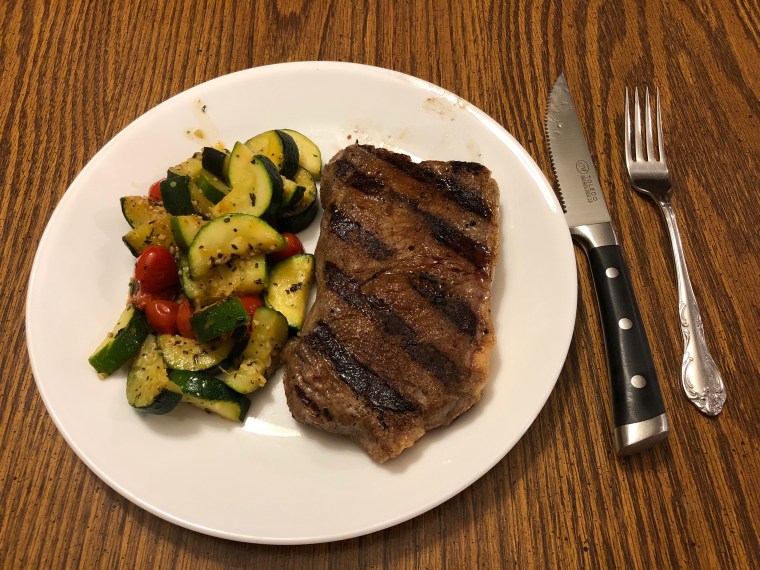
Dinner: We ate a lot of the normal foods that we typically ate on Paleo: steak, ribs, nitrate and sugar-free sausage, and fish, except we substituted sweet potatoes and onions for things like asparagus and a lot of cauliflower.

I had planned to be more detailed and do things like weigh my food and calculate grams of carbs, but honestly, that’s the side of keto that I’m not enamored with. I like the simplicity of Paleo: eat good and healthy foods made from whole ingredients. Eat them until you are satisfied but not stuffed. It has been working for me for two and a half years, and I feel good with what I accomplished on keto but I am happy to be adopting my keto/Paleo hybrid lifestyle.

Modifying our Keto

img_1428It was successful, and I got out of it what I wanted to get out of it; some weight loss and another experience with getting into ketosis (but this time using exogenous ketones) and staying in ketosis. I learned about how to eat at restaurants and the differences in preparing keto food vs Paleo food. What I decided, through a lot of conversations with my wife along the way, is that we’re going to adapt to a combination Paleo-Keto diet.

We enjoy the cheeses. We enjoy sour cream and cream cheese, but we both are lactose intolerant and get bloated/puffy when we eat anything with lactose in it. Worse, I experience digestive distress and can guarantee a violent trip to the restroom within 30 minutes if I eat anything with too much lactose in it. So, that’s a limitation for us. Also, we don’t want to overdo cheeses; just to have the option of using them.

My wife prefers natural sweeteners like honey or agave. I agree that they taste better, but I don’t have the visceral negative reaction to the use of erythritol or other artificial sweeteners in food if used in moderation. We will likely stick to more natural sources of sweetness in small amounts, but making something with artificial sweeteners will be an option now (but again, we aren’t going to lean on it).

Root vegetables: carrots, onions, sweet potatoes, and even others like tomatoes and green peppers will remain in our quiver of available food items. On keto, these are frowned upon due to their carb count, but while Sherry and I have been living LCHF for the past two and a half years, I think our version of LCHF has been moderate. With that said, it’s also been wildly successful, so it can’t be all bad.

Otherwise, I will continue to eat our Paleo/keto foods. Or is it keto/Paleo? I think the latter follows more traditional convention of alphabetical order, but I digress. This keto/Paleo plan is a solid one, I think, and I will be documenting our discoveries and experiences, including good and bad and everything in between.

I think keto is still a great way to get into serious weight loss, and I did feel energized in the mornings and a mental clarity that I hope I don’t lose, but it is too restrictive for our active lifestyles that includes a lot of travel. We also enjoy eating new foods at the places we visit, and being in ketosis severely limits our ability to have a one-off meal here and there easily and without causing a lot of extra effort for us to get back into ketosis. Some would say that we’re being lazy or making too much out of it, but at this point, we’re convinced of the efficacy of the diet we’ve been on for the past two and a half years as evidenced through our combined 215 lbs of weight loss (150 lbs for me, 65 lbs for her).

One of the neat things about this journey has been finding what works and discovering what doesn’t (and discarding or limiting them). There is no one-size-fits-all diet for everyone. I can recommend a starting point for you, but it’s up to you to closely monitor and watch how your body responds to the different foods to adapt your diet to your body. That’s what Sherry and I did with keto/Paleo, and so far, we’re enjoying the benefits in our health and the flavors on the table.

Clear the Itinerary when Starting

IMG_1600I’ve given advice before about when to start a Whole30, Paleo, or keto, but what I didn’t discuss was what goes into your decision to select a start date. There is more to it than just using what’s in your refrigerator or pantry, and stocking up with tupperware or food to prep. There’s more to it than putting together a menu of items to make. There’s emotional stability.

I have discussed what I believe to be the biggest factor in success in any diet: mindset. It takes a lot of determination and setting goals and limits before you even take your first bite of a new diet. Adopting a lifestyle and not accepting failure and not allowing sabotage (what people call cheating on a diet) to happen. These are all important as well, but even if you have the best intentions, made appropriate preparation, and have all the ingredients, you still need to do one very important thing: make sure your life isn’t in turmoil.

Changing your lifestyle and adopting a new diet is very stressful in and of itself. You are changing your relationship with food which is one of the most intimate relationships we have. It can be, and will be quite stressful even in the best of conditions. Trying to take on this stress while going through a stressful time in your life will force you to try to extricate yourself from any stress you can, and your diet and new lifestyle will be the easiest to rectify. Thus, you’re setting yourself up for failure.

Do yourself a favor: make sure your life is in order and things are going well enough that you can take on something like a new diet and lifestyle before you jump in. My wife had a very hard time with doing keto while going through some stressful times at work, and it became very difficult for us to continue together even with the mutual support system we’ve developed. I can only imagine what it would be like trying to go through it alone or without a supportive partner.

Sacrifice for Health

paleomarinecomimages_6_original_bueenboc3zkI’ve heard people say they would do anything for their kids, their spouse, or their friends, but do they really mean it? One of the most special gifts we can give our loved ones is our time, and spending it with them is special, indeed. We limit our available time when our health is poor, as our lifespans are reduced. Why then do we not consider that improving our health actually benefits not only us, but also our loved ones?

That brings us to sacrifice which is giving up something at a cost to our comfort, safety, or giving up something important to us for the benefit of others. Most people view sacrifice as something to be avoided until the last possible chance. Why sacrifice when there is not much pertinence to it? That’s why so many people don’t start doing something about their health until they’ve been told by a doctor that their life depends on it.

Sacrifice doesn’t have to be something that makes you miserable. Sacrifice can be just giving up something like pizza, bread, pasta, and alcohol. For some, this may seem like a sacrifice at first, but as you get used to it, you realize how silly it was to think that not eating certain foods would affect the quality of one’s life so much. In reality, giving up some of my favorite foods has made my life richer, fuller, and healthier. I am now able to do things I never dreamed of doing when I was 40, let alone now that I’m 50. I sacrificed pizza, pasta, bread, and alcohol for a better life, and possibly a longer and healthier one, too. I call that a fair trade.

Think about your priorities. I mean really think about them. If certain foods and/or alcohol are a priority to you, perhaps there’s a bigger problem you should be looking at. There is no reason to stick to foods that work against your good health and cause you to gain weight, and there’s definitely no reason to rely on alcohol to get you through the day.

I sacrificed, and I am better for it. I sacrificed not only for myself, but for my wife, my kids, my family, and my friends. I sacrificed and in the end, didn’t feel like I really gave up anything of value at all. It’s like a cheat code to life that requires some up-front uncomfort, but it pays off with a richer, fuller, and healthier life.